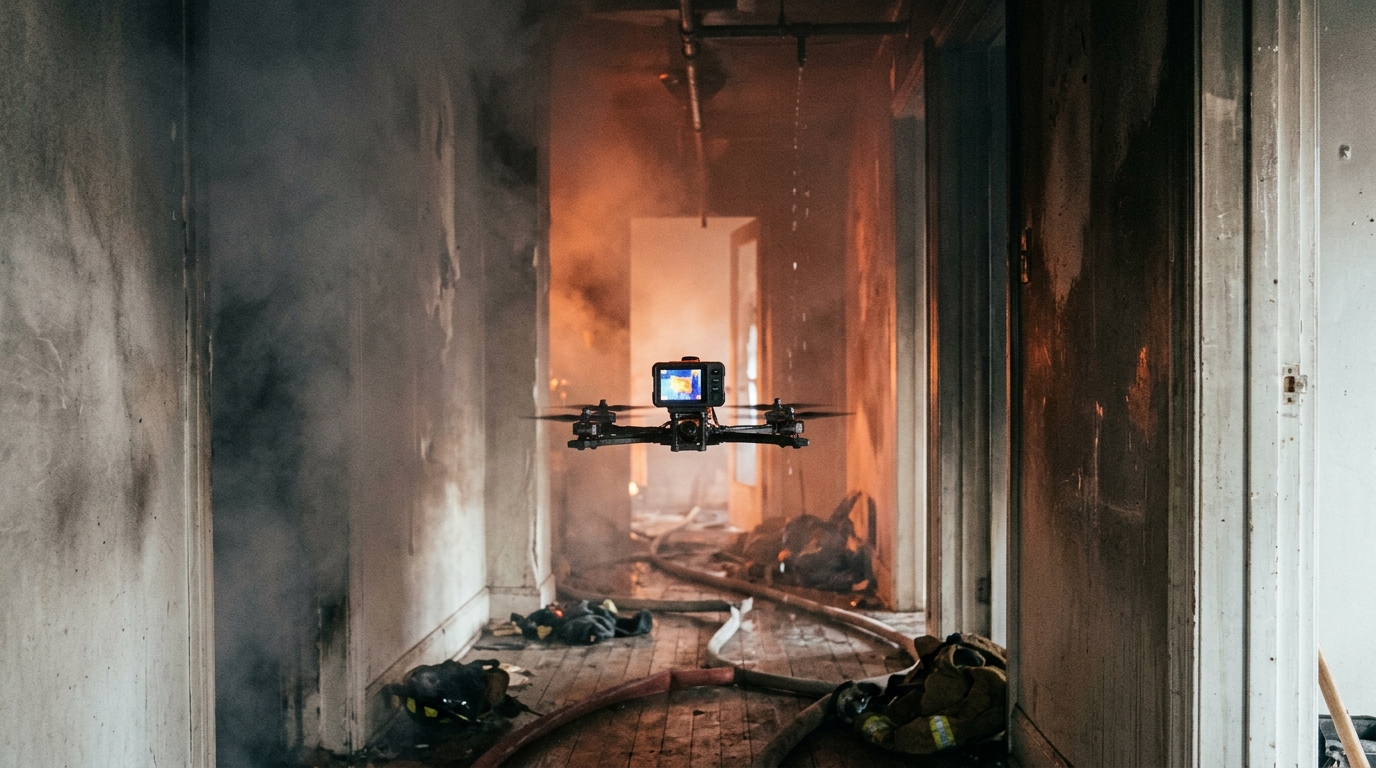
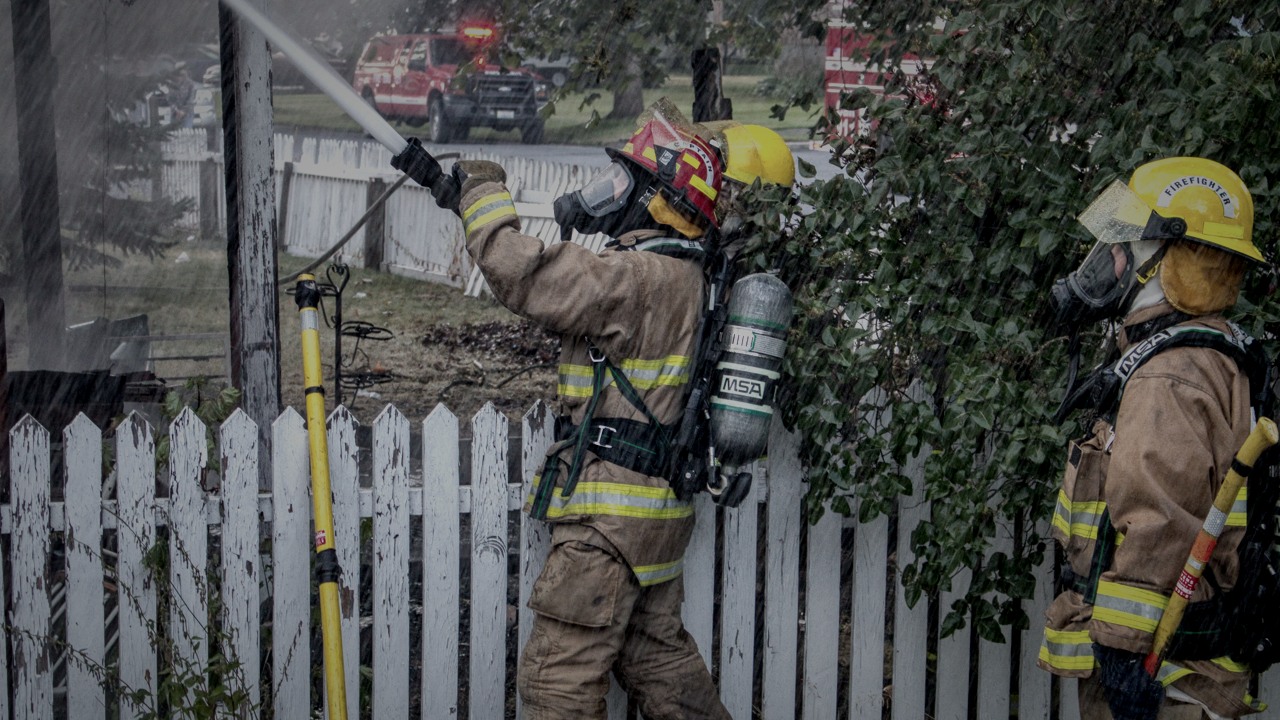
AI-generated editorial illustration, not a photograph of the reported equipment or event
ROBOTICS / FIELD RESEARCH
A Growing Robot Inspected a Battery Warehouse After the Fire
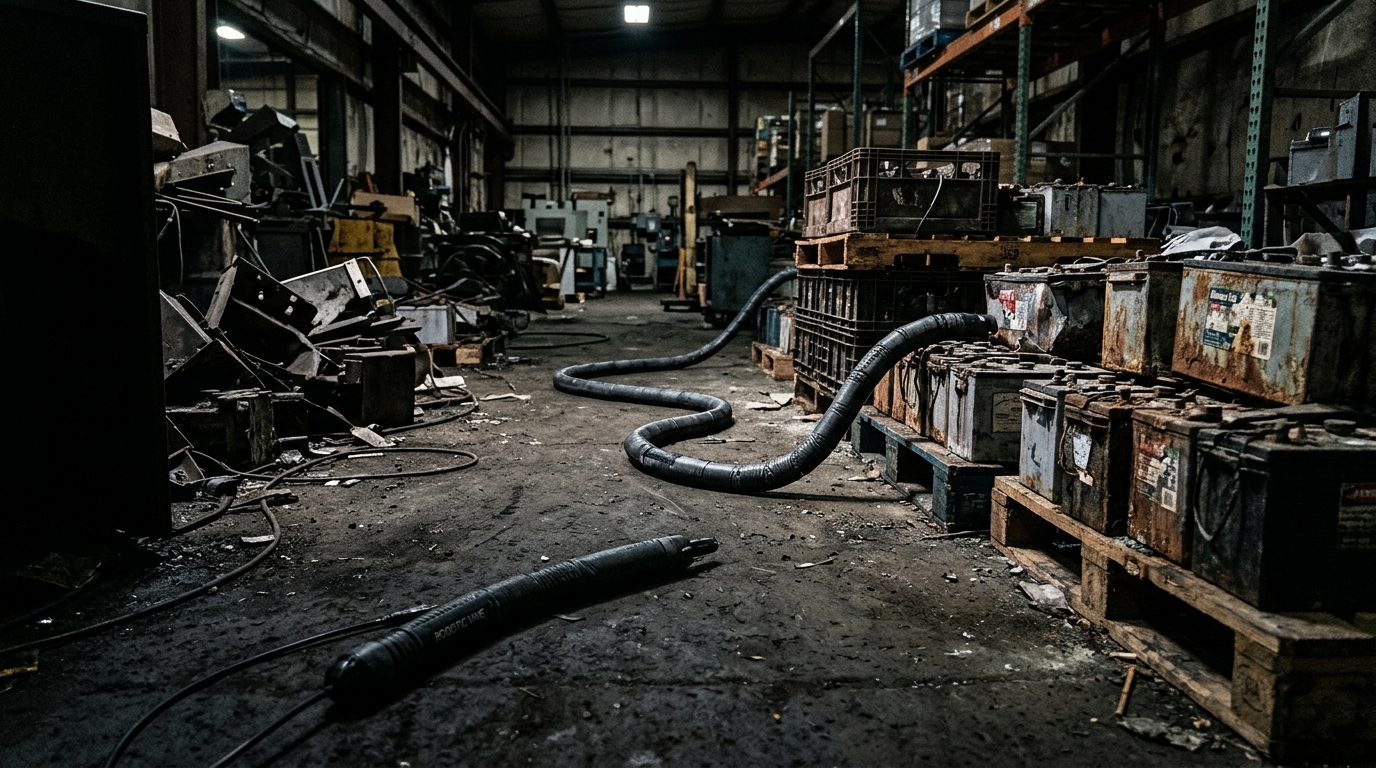
The fire had been extinguished. The problem left behind was a warehouse containing heat-exposed, unburned primary battery packs that could still undergo thermal runaway. South Korea's National Fire Research Institute and KAIST reported using a lightweight, pneumatically growing vine robot to inspect the interior after an August 2026 fire in South Chungcheong Province. The fire agency's October 12 release describes the reconnaissance; it is not a report of a robot moving through an active interior fire.
The reason for choosing a soft robot matters more than its resemblance to a plant. Authorities considered tracked and four-legged machines but worried their weight could press on batteries scattered across the floor and trigger another event. The vine robot extends using compressed air, reducing the ground loading associated with a vehicle driving across the debris. Operators worked remotely from a protected safety area. The announcement reports interior reconnaissance but does not establish a standard sensor package, travel distance or an off-the-shelf purchase option.
This is a separate team and incident from Notre Dame's SPROUT work. The transferable lesson is to specify the access problem before specifying the robot: floor loading, gaps, obstacles and operator exposure can matter as much as camera resolution. For US departments assessing remote reconnaissance options, ask what data the device returns, how communications behave through the structure, and how a stopped or damaged device is recovered without creating another entry problem.
The take: A real incident is stronger evidence than a promotional animation, but one research deployment is not a validated capability across battery sites. Keep primary batteries distinct from rechargeable lithium-ion installations, and do not turn a post-suppression reconnaissance example into a new entry tactic.
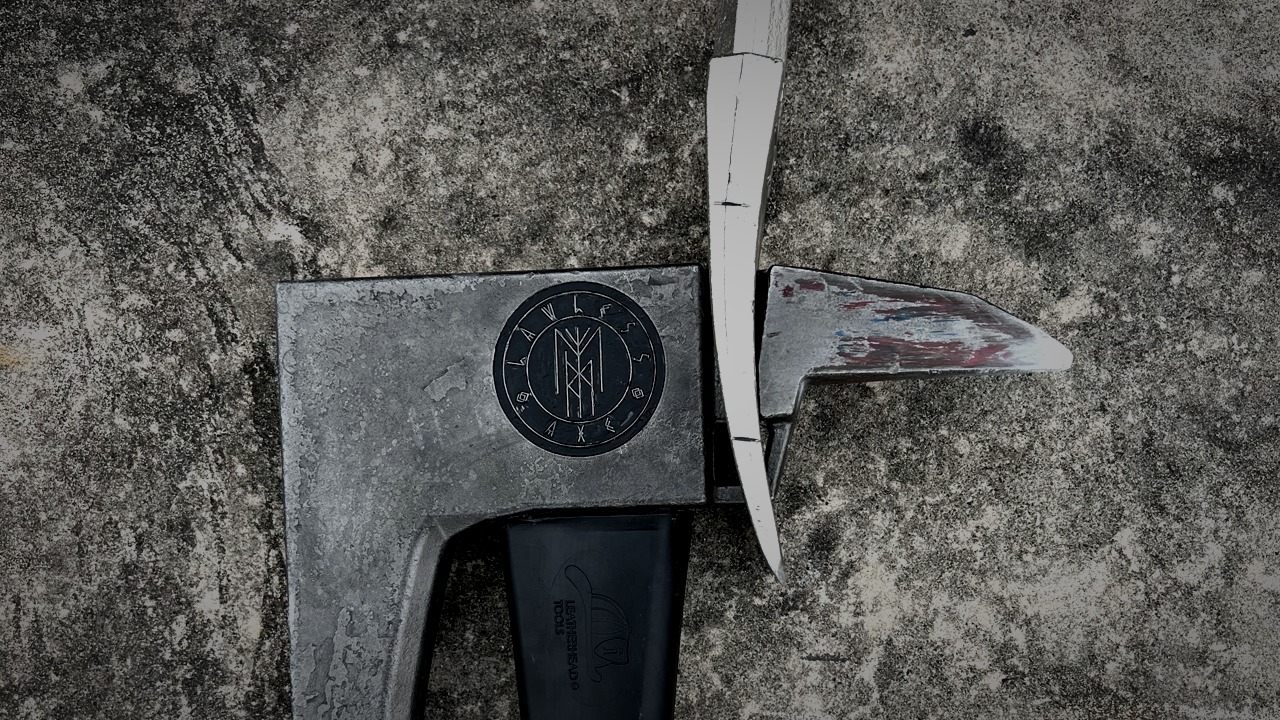
Lawless Brothers Fire Tools, actual manufacturer photograph; cropped and color-graded by The Overhaul Brief.
TOOL INNOVATION / ORIGINAL ANALYSIS
An Axe That Locks Onto Your Halligan Without a Strap
An axe that buries itself in roof decking makes you spend the next movement getting it back. Firefighter brothers Tom and John Lawless tackled that problem with an unusually long beard, a broad striking face and a pass-through that locks onto a Halligan. The result is the Lawless Axe, an existing tool getting a closer look in an October 1 Fire Apparatus feature, not a newly announced October product.
The interesting part is the geometry. The magazine describes a narrow, extended beard intended to penetrate roof decking while keeping the rest of the head from burying, then act as a ramp during withdrawal. The manufacturer describes an eight-inch striking face, a pick shaped like a standard aluminum fire wedge and a marrying pass-through designed to secure a Halligan without a strap. It also describes using the connection to extend a Halligan for more leverage. Those are design intentions and manufacturer claims, not results from an OB field test.
That gives a truck company a concrete comparison to run in supervised training: does the head release more cleanly from the roof assemblies in your district, and does the pass-through securely fit your actual Halligan? Compare carry security, separation with gloves, balance, fatigue and compatibility with the current irons. The long beard and larger head may solve one problem while changing clearance and handling somewhere else. As checked October 25, the maker lists the axe at $275 and says it is in stock, shipping within 12 business days.
The take: A specific mechanical change is worth more attention than another generic multipurpose-tool claim. The Lawless design earns a hands-on comparison, not an automatic purchase recommendation. Ask for a demonstration with your tools and training props; no independent comparative performance results were established for this brief.
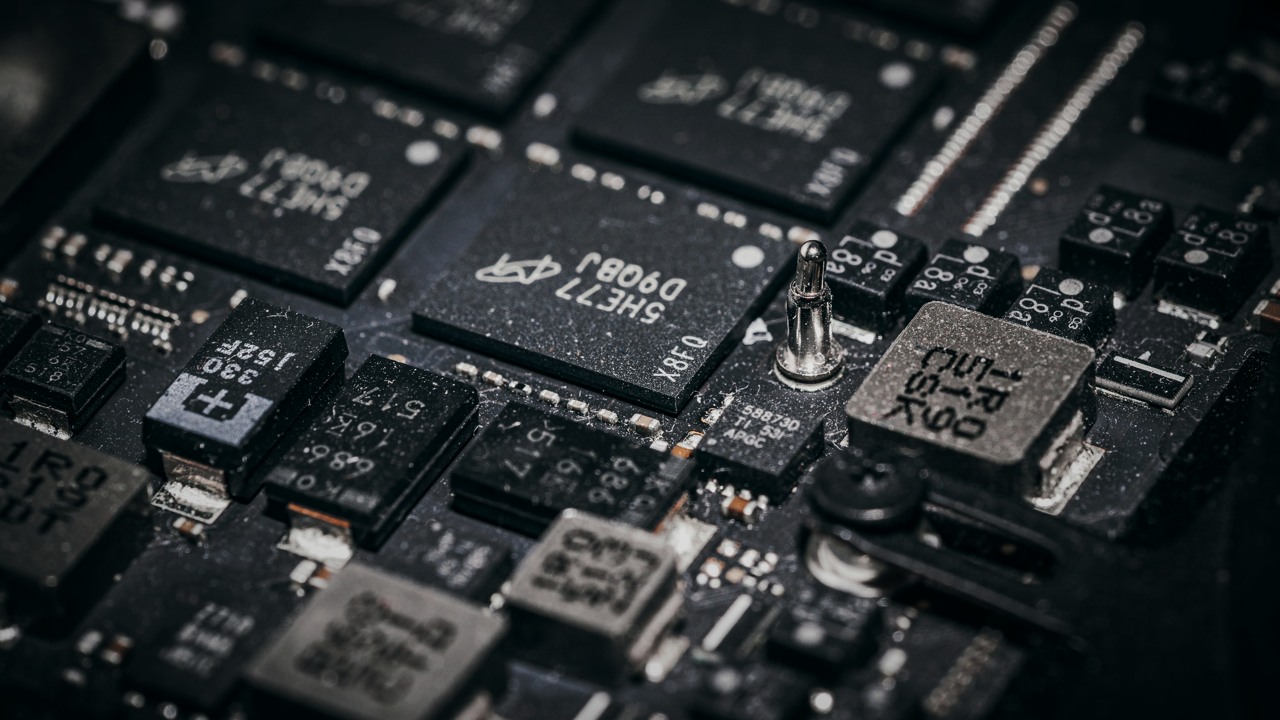
Jakub Pabis / Pexels. Illustrative electronics photograph, not the reported module; cropped and color-graded by The Overhaul Brief.
EDGE AI / FIELD PILOT
Your Fireground AI Should Work Without the Cloud
Before the next AI equipment demo, ask the vendor to disconnect the internet. That is the useful question behind a new Taiwanese fireground sensing pilot from Infineon and the Taiwan Guardian Alliance. In an October 6 TechNews interview, the partners described a compact module combining a camera, millimeter-wave radar and an on-device processor. The design puts the analysis beside the sensors instead of sending every image to a distant server and waiting for an answer.
Infineon says its PSOC Edge processor handles local inference, with XENSIV radar and AIROC Bluetooth/Wi-Fi providing sensing and local connectivity. The partners describe mounting the module on existing apparatus, robots or drones. Four Taiwanese fire-service units are participating in application testing and field validation, according to United Daily News's October 2 report. This is a field pilot, not a US product rollout or independent proof that AI reliably locates people in a fire. The published accounts provide no independently verified detection accuracy, heat tolerance or operating range.
The distinction that matters to a crew is between losing the internet and losing the local radio path. An onboard processor can keep analyzing data without a cloud connection; that does not guarantee a remote operator can still receive it. Ask which functions survive each failure separately, what the operator sees when a link drops, and how the system marks stale or uncertain information. Then check battery runtime, processing delay and the environmental limits of the complete mounted package. A successful connected demonstration answers none of those questions by itself.
The take: Make the disconnected demonstration part of the evaluation, not a surprise after purchase. Local AI can remove one dependency; it does not remove communication failures, sensor limits or the need for a human to verify the result.
AI-generated editorial illustration, not a photograph of the reported equipment or event
AI / RESEARCH
Smoke Hides People. What Can Thermal AI Recover?
A camera feed is only useful if the operator understands what it misses. Researchers working on GUIDE2FR combined visible and thermal cameras, onboard processing and a Wi-Fi connection on a drone, with a ground station to display and store the information. King Juan Carlos University describes validation with one drone at two firefighter training towers, in clear and smoky conditions, using people and a mannequin.
The university reports that combining visible and thermal imagery reduced the person-counting error in smoke from 0.35 to 0.23 compared with visible imagery alone. That is about a 34% reduction in the reported error metric, not a 34% improvement in rescues. The full journal methods and sample sizes were not independently reviewed for this brief, so the result should be read as the university's account of a bounded experiment.
The platform does not establish solved autonomous search inside a burning building. The same university account lists more robust autonomous navigation, obstacle avoidance, more complex fire scenarios and multi-drone coordination as future work. The immediate lesson for a US department evaluating remote search equipment is to ask for missed-person examples, not just successful detections: what happens when thermal contrast weakens, a person is partly hidden, or the video link drops? Who interprets an uncertain result?
The take: Separate finding a person in a test image from navigating to that person and supporting a rescue. This study is evidence about sensing under described conditions, not a procurement-ready autonomous interior-search system.
EJ Merl / Pexels. Illustrative hose-operation photograph, not a Mercedes product demonstration or patent test; cropped and color-graded by The Overhaul Brief.
EQUIPMENT / ORIGINAL ANALYSIS
A Hose Patent Targets the Kink at the Nozzle
The last stretch of an attack line has a different job from the hose behind it: it has to move with the nozzle while resisting the bend that can choke the line. A Mercedes Textiles patent application describes adding a third jacket to only part of the hose, near the end, rather than stiffening its entire length. The engineering question is whether that local reinforcement can improve low-pressure handling without making the whole line harder to pack and advance.
US20260009479A1 was published January 8, 2026. It is an application, not proof of performance or a granted patent. Separately, Mercedes offers ExoMetro LPX and KrakenEXO LPX hose with what it describes as reinforced nozzle-end construction. The company advertises ExoMetro LPX for 150-200 GPM in 50-75 PSI applications and the smaller KrakenEXO LPX for 150-160 GPM. Those are manufacturer claims, not OB measurements or pump-discharge instructions. We have not established that this particular patent application covers either product.
That distinction suggests a better demo than watching a straight line flow in a parking lot. Under the department's existing training procedures, compare candidate hose with the current hose/nozzle package: measured flow and pressure, kink formation during representative bends, nozzle-end handling, charged weight, packing, couplings and serviceability. Record where reinforcement stops helping or simply moves a bend farther back. Ask for the actual hose length and test configuration behind each vendor claim.
The take: Buy the demonstrated improvement for your hose/nozzle package, not the patent language. This is new-to-OB equipment analysis of older documents, not an October launch. Independent comparisons, delivered pricing and the patent-to-product connection remain unverified.
Network photograph from the existing OB image library; illustrative, not evidence from the Columbus case. Cropped and color-graded by The Overhaul Brief.
CYBERSECURITY / ACCOUNTABILITY / ORIGINAL ANALYSIS
Columbus Firefighter Data-Breach Lawsuit Gets Another Day in Court
A Columbus firefighter is among the plaintiffs whose lawsuit over the city's July 2024 cyberattack can proceed after an Ohio appeals court reversed its dismissal on September 24. The opinion recounts allegations that the firefighter received alerts about a compromised credit card and that his Social Security number and work email were available on the dark web. The court did not decide that Columbus was negligent or award damages. It decided that dismissing the case on immunity grounds at this early stage was premature.
That distinction matters. The city argued that its IT infrastructure supported governmental services, including police and fire. The appeals court focused on the activity alleged to have caused the harm: operating shared IT infrastructure and safeguarding sensitive personal data. On the complaint as pleaded, the city had not conclusively established immunity. The case goes back to the trial court, which still has to address the city's further immunity defense and the unresolved merits.
For a fire department, the useful question is where its responsibility ends when personnel records live on a shared municipal network. Ask municipal IT and HR to map who can access those records, who owns breach notification and how firefighters receive usable help when their personal data is exposed. Have those owners walk through a tabletop incident using the actual escalation contacts. This Ohio ruling is not a nationwide liability rule, but it is a concrete reason to replace vague assurances about city IT with named responsibilities and documented controls.
The take: The city has not lost the case; the plaintiffs have regained the chance to pursue it. Keep the legal outcome narrow and the operational lesson concrete: shared infrastructure does not make responsibility for firefighter data disappear.
AI-generated editorial illustration, not a photograph of the reported equipment or event
AI / DISPATCH WORKFLOW
Boulder Is Testing AI on the Non-Emergency Line, Not 911
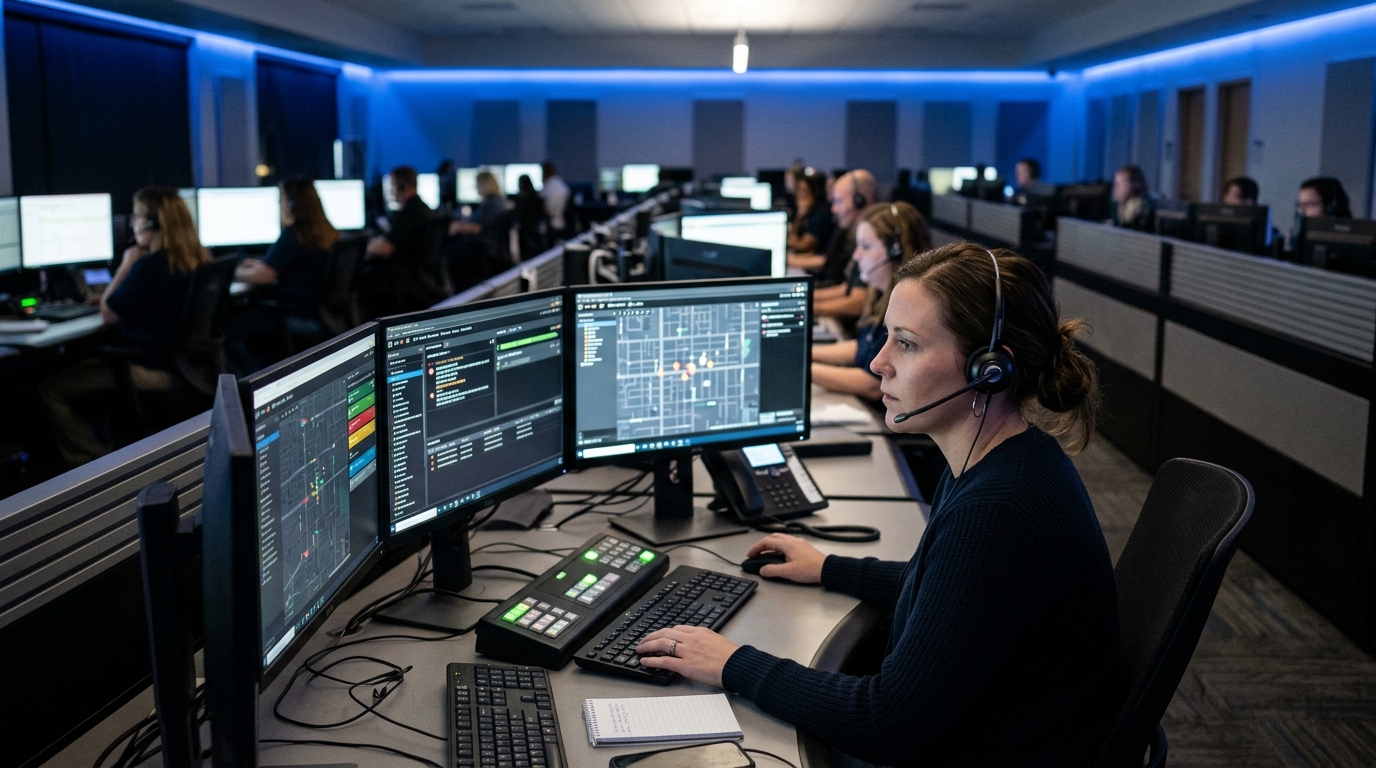
Boulder's public guidance describes a soft launch of ANET, Automated Non-Emergency Triage, at the end of October: a few hours at a time, several times a week, while staff monitor performance. The assistant is intended to collect details, answer routine questions and route calls on the police and fire non-emergency line. Every 911 call still goes to a trained dispatcher. The AI does not answer 911.
The city says callers can request a dispatcher at any time. ANET reads back important details and a summary, and it is designed to transfer calls when it recognizes an emergency or cannot help. Dispatchers can see the live conversation and intervene. Those are the proposed operating safeguards, not proof that every emergency will be recognized correctly. The phased rollout is an opportunity to measure where the handoff succeeds and where a person has to repair it.
A department considering the same workflow should separate reduced hold time from reduced workload. Measure time to a human, emergency-escalation misses, abandoned calls, incorrect addresses and the time dispatchers spend correcting summaries. Include callers who switch languages, describe a routine matter that becomes urgent, or simply ask for a person. The share of calls classified as non-emergency is not the share of labor that automation has saved.
The take: The useful pilot result is a safer, faster handoff with less total rework. Do not count promised time savings before observing them, or use a limited-hours non-emergency trial as evidence that AI is handling emergency dispatch.
FireMic turns a spoken account of a call into NERIS report fields for the firefighter to check. Its website says nothing files without review and missing information comes back as a question. The useful evaluation is not whether AI can write prose: compare the original account, populated fields and corrections against a completed report, including what happens to the recording and transcript.
A specific voice-to-NERIS workflow, with review burden and data handling to assess rather than a generic AI-writing pitch.
Cost: First month free, then $5 per firefighter per month; department terms available from the vendor.
Vendor-described workflow; NERIS compatibility is not an endorsement. Confirm storage, retention, access and RMS integration before using real incident data.
Beyond this week: the next generation of firefighter simulation tools should show how instructors diagnose a missed cue, not just how realistic the scenario looks. We are looking for evidence that training feedback changes the next performance.
Get The Overhaul Brief Every Tuesday
Fire service intelligence delivered to your inbox. Join thousands of fire service leaders who rely on The Overhaul Brief to stay ahead.